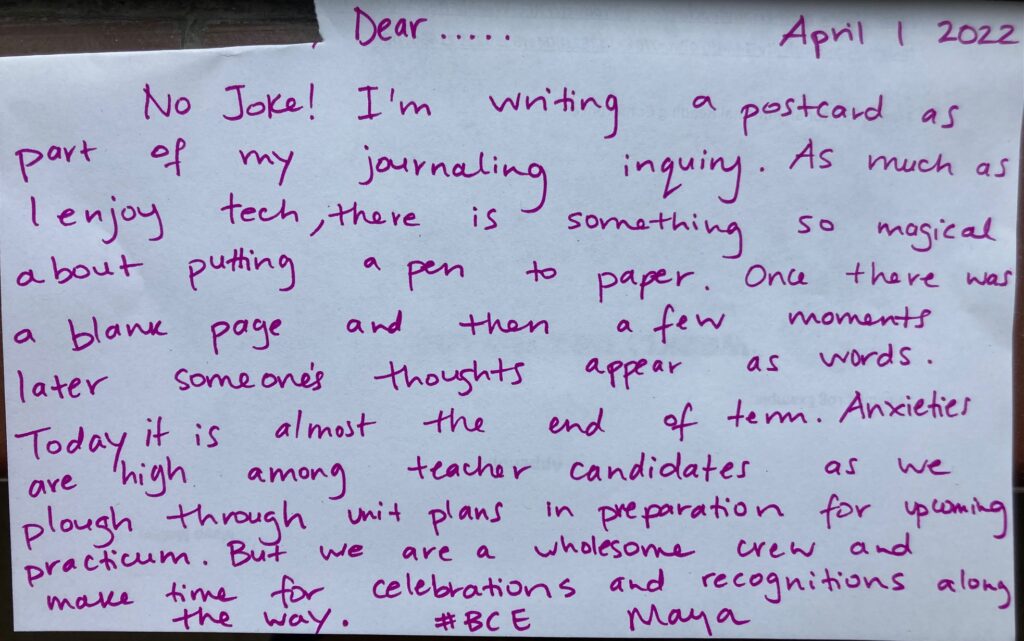
For the last day of tech class, I chose to transcribe a little journal entry by way of a postcard I might send out to someone.
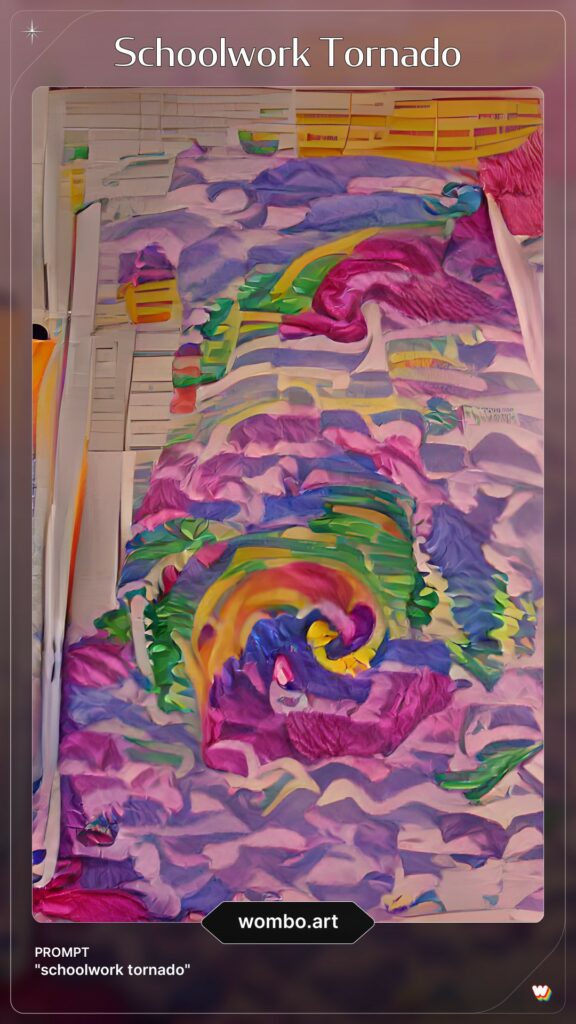
To create the image or “front” of my postcard, I used a newer app that our instructor introduced us to called WOMBO which allows you to create beautiful artwork using AI. Today I entered the prompts schoolwork tornado and wombo made me this
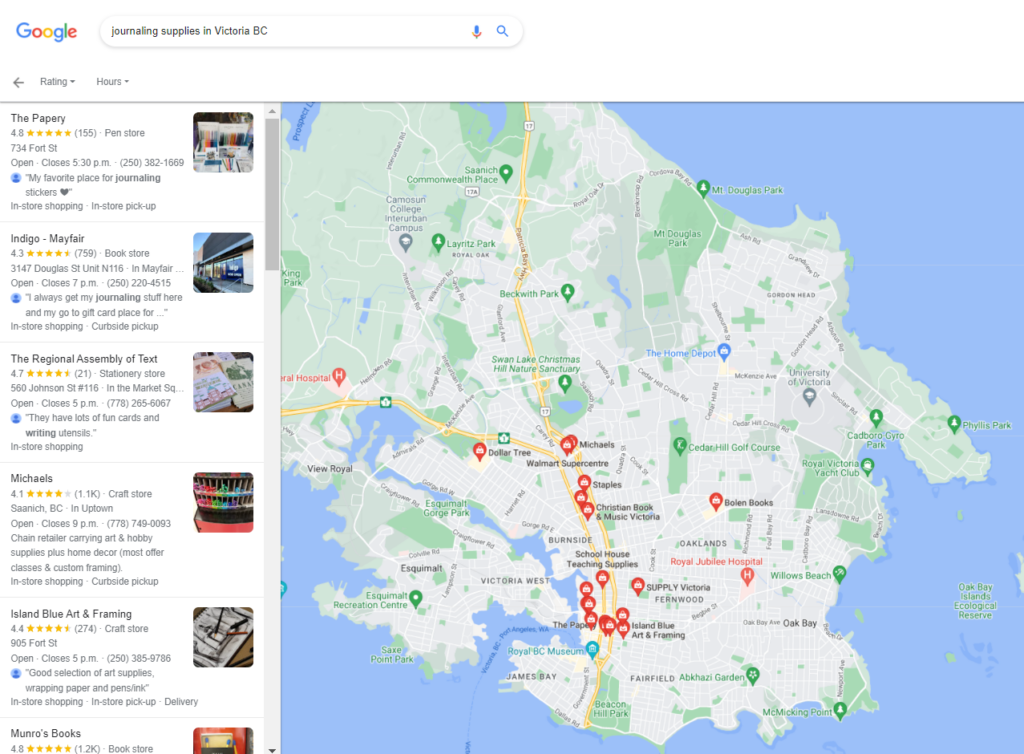
One of my favourite things about journaling is the day I get to purchase a fresh new journal. There is something so satisfying about a crisp new page. I’ve had many journals over the years and I thought I might research a few local places to go and buy journals. I am a big believer in shopping local and when possible will take an opportunity to buy from a local business. A quick google search presented a few options…
From here I was able to do a little research and see which of the local google listings matched my criteria for supporting a locally owned business. The first one I checked out is called, The Papery. Although I have shopped in the papery many times I didn’t know if it was a locally owned business. I wasn’t able to find the information I was looking for on their About Us page but I was able to find this article from the local Times Colonist that highlights the local owner, Michael Rodgers, as well as a recent move. As a side note, I tried to embed the Times Colonist in this blog post but was blocked by a message saying sorry, but this content could not be embedded. I suspect that the Times Colonist has created a block on their content but hope that I am properly crediting them here by using g a screen shot and including a link that will send you their website.
My next search was into Munro’s Books which is an iconic book store located in downtown Victoria, BC. The Munros website had substantially more information about the business and I learned that when the original (and local) owner decided to retire, he transferred ownership of the store to four long-term employees of the famous bookshop. What a feel-good story! Here are some images of the famous Munros bookstore located at 1108 Government Street courtesy of Tourism Victoria.
After completing some research, I am now informed and will never again order a journal from amazon when I have at least two fabulous and local stores to shop from close to home.
Then I talked to a teacher who was leading their class through a photo essay and I started to consider applying this model to journaling. A photo journal could be multiple photos placed together in order as a way to document one small journey (maybe just one day) or curated over a lifetime to tell a story. I decided to try curating 6 photos from sometime in the fall that might offer a glimpse into what kinds of things I do outside of school. What follows is my photo journaling entry…
As a preservice teacher today I thought I might head into the BC Curriculum resources and see if I can find anything about journaling. A quick search for the actual word journal or journaling didn’t bring anything up so I opted to look a little deeper in the English Language Arts and Career curriculum for something that might support the use of journaling for students. The Following are the highlights of what I found.
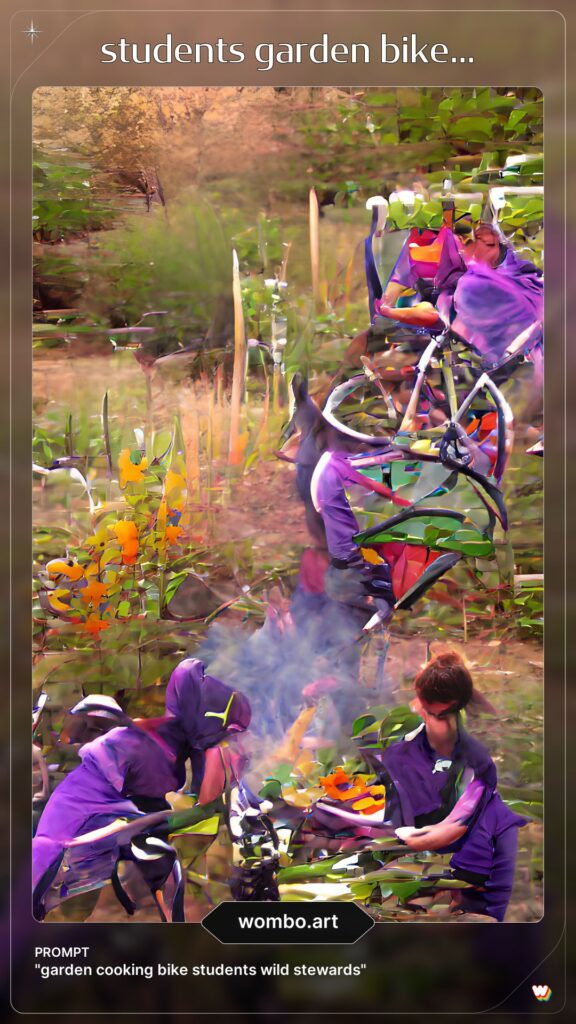
Misha and Alex meet on the street to walk to school together. It’s October and they are dressed in rain gear. Upon arrival at school, they are assigned their caretaker roles for the day. Misha is assigned to tending to the compost and Alex is assigned to the canning shed. They spend the next three hours in the school garden moving compost into wheelbarrows and sanitizing jars for the tomato sauce they have been making over the last three days. As Misha aerates one pile of compost he takes in the smell of decomposing leaves, garden clippings, and food waste. His teacher stands beside him and asks him to describe the smells and asks him to use his senses to tell him when the compost will be ready for the garden.
As the sun gets higher in the air, the teacher calls out to the group of students that it is time to prepare lunch. The students make their way inside the school building. After hanging raingear in the mudroom and washing their hands, they enter the garden pantry and select the items they will need to prepare today’s lunch. Misha is excited because it is Tuesday and Tuesdays are his dad’s day to come and help the students make lunch. Today they are making minestrone with carrots, rutabaga, celery, and kale harvested from the school garden. Misha catches a glimpse of his dad entering the kitchen area with the other adults that come on Tuesdays. Each student greets their assigned parent or community members and lunch preparation begins. From peeling vegetables to mixing soup base, to setting the tables everyone has an important role.
After lunch, a similar scene unfolds as each person knows what their job is for the collective cleanup and preparation for afternoon inquiry. Misha says goodbye to his dad and joins Alex and the other Tuesday dishwashers. As they wash up the dishes, their conversation turns to afternoon classes where they will spend the rest of the day in a bicycle workshop. Misha and Alex walked to school as per the school’s no car policy but only because both of their bikes are in the shop and if they are successful they should be riding home from school this afternoon.
When I asked some of my teacher colleagues what their thoughts were on journaling, I got a lot of interesting and varied responses. I promised I wouldn’t share their thoughts as part of my inquiry but one of them asked me this question:
Does Twitter count?
Naturally, I went to Twitter to see what other people were saying about journaling…
Therapist: “have you tried journaling?” Me: *oversharing my deepest issues on Twitter * “yes.”
After doing a few journaling searces in the Twitterverse it seems clear that there is no solid consensus about whether or not tweeting counts as journaling. However, there does seem to be a consistent thread linking journaling to therapy, counseling, and mental well-being which led me to ponder how journaling can reduce stress and anxiety and promote positive mental health? This time I decided not to search on Twitter for evidence but rather went searching for scholarly research. Here is a video of me explaining my search process
After searching in the UVic library summons, I did find research that supports that gratitude journal writing can support positive mental health. Here is a quote from the abstract from one article I found:
About 4 weeks as well as 12 weeks after the conclusion of the writing intervention, participants in the gratitude condition reported significantly better mental health than those in the expressive and control conditions, whereas those in the expressive and control conditions did not differ significantly.
Y. Joel Wong, Jesse Owen, Nicole T. Gabana, Joshua W. Brown, Sydney McInnis, Paul Toth & Lynn Gilman (2018)
Back to my original question does Twitter count as journaling? It seems like it might not matter what medium you use as long as you are expressing gratitude. I’m already thinking that my next post will try and compare journaling with paper and pen vs. keyboard and social media. Stay tuned!
Today I revisited some of the things I learned in this class and applied them to my inquiry. As I reflected on my last post about what to do when facing writer’s block, I thought about how I might support my future students when they are faced with the same challenge. I went back to our class about image editing to create some visual writing prompts I might use in a classroom to help students practice writing. This could be in the form of a morning message or a warm-up activity for an ELA lesson.
In today’s class, I enjoyed a presentation from a local middle school teacher, Joanna Lake. The title of Joanna’s presentation is Fostering Connectedness and Digital Assessment but she covered so much more! I really appreciated the opportunity to hear from a professional who is actually teaching right now because their experiences feel so much more relevant to the in-person practicum I am preparing for.
The key ideas that I want to remember from Joanna’s presentation:
Building connections in a low-risk way when first meeting students. Low risk activities closed option choices (like a game of would you rather and mood scales).
Create a morning routine that is consistent. A consistent morning routine builds predictability for students which ultimately leads to feelings of comfort and safety. Some of Joanna’s ideas include posting a joke of the day, making and playing a class playlist, using mood scales to check in with students.
Use surveys to get to know students. Make sure to ask them what type of learning works best for them. Do a survey – what type of learning works best for you.
Go slow – pick one thing you want to master during the morning routine or when making connections and focus on that. Don’t try to do it all in your practicum or first year of teaching.
Use visuals – a lot. Especially in middle school. This includes memes, videos, GIFS, slides, anything!
Post a visual schedule of the day – this is not just for early primary. This practice is helpful in K-12 classrooms to create predictability.
Use a Google slides for morning message and after lunch message to help focus student’s attention on most important tasks, reminders, and actions for the next block of time together.
Only show the rubric for proficient within the Proficiency scale. This benchmark allows students to highlighting and draw arrows (towards developing or extending) for each point in the rubric when assessing their own work.
Always use mentor texts. This helps students learn to write properly.
Joanna introduced us to an excellent tool that can be utilized for digital assessment called Flipgrid. Flipgrid is essentially a video creation platform that can be used by students to record their evidence of learning. This evidence can then be self, peer, and teacher assessed. This is a powerful tool for learners who are better at expressing their learning by speaking vs writing. I’ve included a great getting started video on Flipgird below
Overall it was a fantastic presentation that was thoughtfully planned with pre-practicum teacher candidates in mind.
Sometimes the hardest part about journaling is having something to write about. I can set up the perfect journaling session by taking advantage of a quiet house, pouring myself a fresh cup of coffee, setting out a clean piece of paper, and having my favourite pen ready and then…..nothing. As I stare at the blank page in front of me I just don’t know what to write.
A quick google search for journaling prompts led me to this helpful acronym from journaltherapy.com. The prompt uses the acronym WRITE to help get past that block…I’ll call it journaler’s block. The acronym stands for
W – What do you want to write about? A feeling, an event, whatever.
R – Review or Reflect on it.
I – Investigate your thoughts and feelings.
T – Time yourself. Write for 5-15mins.
E – Exit by re-reading what you wrote and write one or two sentences of reflection.
As I began researching the author of this acronym, I found out that this prompt is part of a journaling course led by Kathleen Adams somewhere during her 30-year career as a thought leader and global influence in the field of therapeutic writing. Not only did I learn how passionate Kathleen is about journaling, but that one can train to be a Certified Journal Therapist (yes, it’s a thing) through the Therapeutic Writing Institute. Early in my inquiry journey, I had the suspicion that there must be some major benefits to journaling because many friends talked about using it as a form of self or practitioner-prescribed therapy. Now I am starting to find evidence to support this. But I’ll save that for another post.
Today, I am focused on journaling prompts so here are a few more for the days when I just don’t know what to write about:
Write about a public figure you’ve long been fascinated with from afar. What first drew you to them, and why? How has the fascination evolved? What does it tell you about yourself?
“Imagine that you’re suddenly the older version of you — 5, 10, or 15 years in the future. If you sat down over wine or coffee with the current, younger you, what advice or observations might you offer?”
I had been making great progress on my journaling inquiry project. I had a solid week of waking up at 6 am and journaling for 30 mins while and was enjoying the Artists Way Morning Pages Journal, which I talked about in my last post. And then I was forced to participate in setting my clock an hour forward as part of the tradition of daylight savings time and waking up at 6am became an almost impossible mental feat. Where I had been starting to notice the lightening of the sky and eventual rising of the sun during my morning journaling time, it was now dark and I was consistently choosing to stay in my bed for an additional 30 minutes. I had optimistically planned to write my journaling pages later in the day but I had heard that journaling is best in the morning.
This Masterclass article even suggests that the morning is THE time to journal, quoting that “Morning is the optimal time of day for stream-of-consciousness daily practice. Your morning brain is fresh. Write your pages before you fill your head with any outside influences.” I agree and was really starting to enjoy the morning practice of brain dumping and found myself feeling mentally lighter as I embarked upon my daily responsibilities.
Now that I’ve had an extra week to process this shift in time, I’m ready to return to my morning pages and enjoy the benefits of this practice. And if you are like me and found yourself wondering if daylight savings time clock changes are going to stop, you can watch the latest here:












Recent Comments